Pressure testing: confirming and isolating a leak
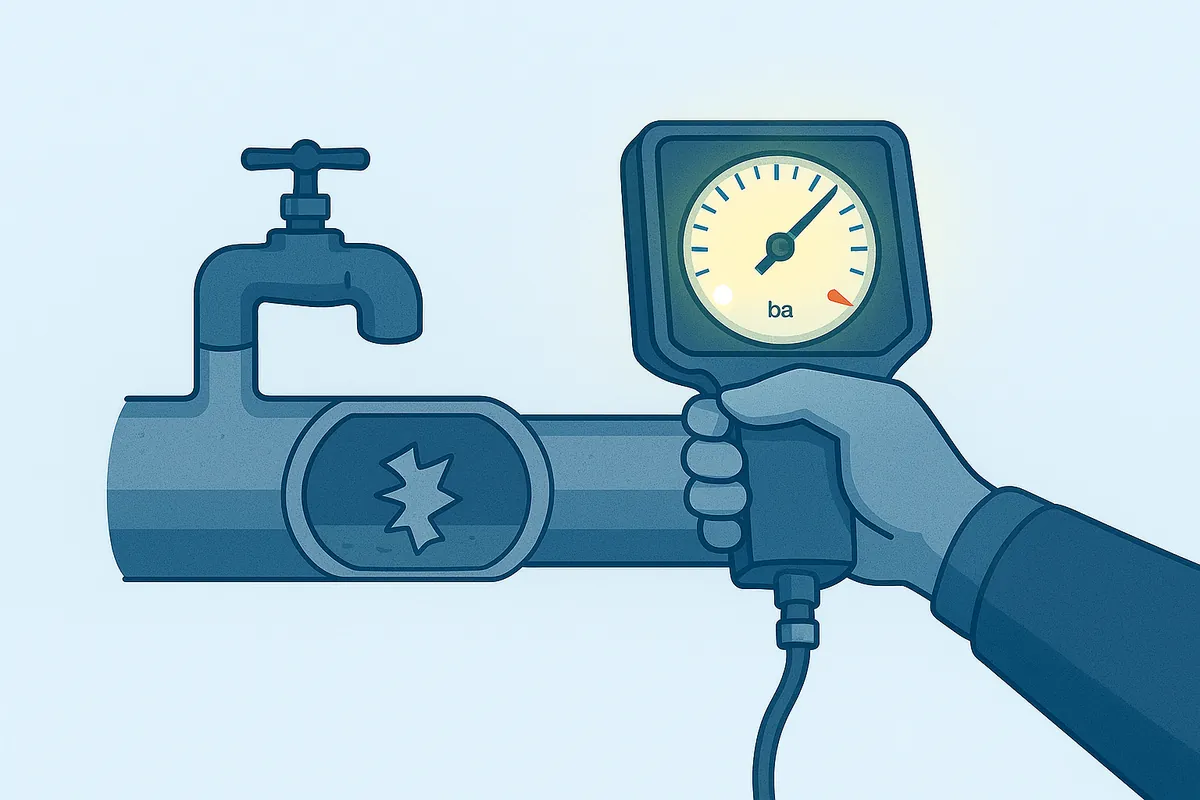
A pressure test is often the first step in a leak search. A circuit is isolated, pressurised and watched on the gauge: if the pressure drops, the circuit is leaking. It is simple but essential: it confirms that there really is a leak, and tells us which circuit to look on.
How it works
Valves are closed to isolate each circuit: cold water, hot water, secondary return, heating, and each loop of an underfloor heating system from the manifold. Each one is brought to a test pressure and watched for a set time. The circuit that loses pressure is the one that is leaking.
When we use it
- high water consumption with no visible signs;
- a boiler that keeps losing pressure;
- before locating a leak with thermal imaging or tracer gas, to target the right circuit;
- after a repair, to check that the circuit is watertight again.
Limits
A pressure test tells you whether a circuit is leaking, not exactly where. It does not apply to drains, which are not under pressure. A valve that no longer closes properly can skew the result: we take this into account when interpreting it.
Related pages
Tracer gas
A nitrogen-hydrogen mix that rises to the surface directly above even the smallest leaks.
Read moreAcoustic detection
Electro-acoustic listening and correlation: the sound of water escaping under pressure.
Read moreHigh water consumption
Abnormal bill, meter turning: finding the leak that leaves no trace.
Read moreA leak, water ingress, an insurance claim?
Describe the situation and we'll tell you how we would proceed. 24/7 emergency service.