Leak detection on heating and underfloor heating
A boiler that loses pressure and needs regular topping up is the most common sign of a leak in the heating circuit. With underfloor heating, the pipes are embedded in the screed: the leak can't be seen, and opening the floor at random is expensive. Expomis pinpoints the leak without demolition.
Signs of a heating leak
- boiler pressure drops and you have to top it up regularly;
- one area of the floor is warmer than the rest, or a stain appears on the ceiling below;
- damp at the foot of a wall or under a radiator;
- floor covering coming loose or wooden flooring swelling.
Before looking for a leak, check there is one
Pressure loss does not always come from a leak in the floor. A deflated expansion vessel or a discharging safety valve can cause the same symptom. We check these components, then pressure-test the system loop by loop at the manifold to identify the one that is leaking.
Why thermal imaging works well
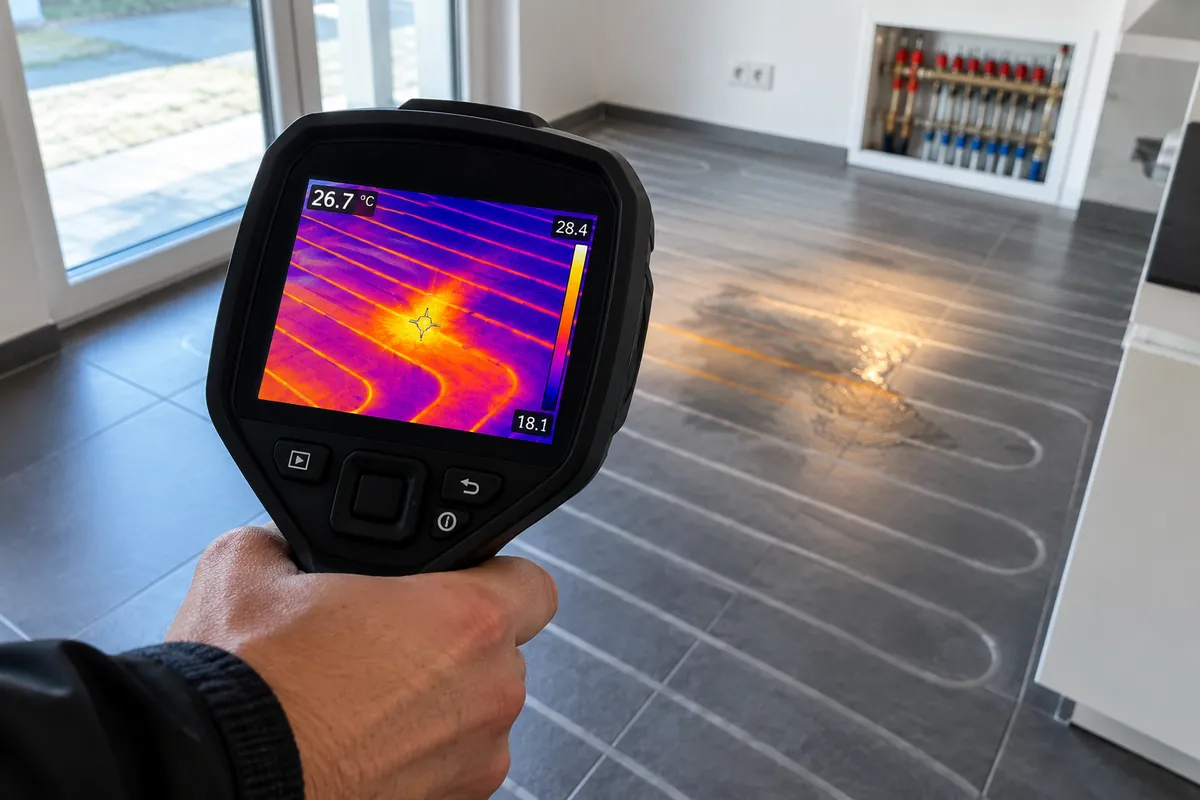
Heating is a hot circuit. When it is heated up, the thermal camera reveals the route of the pipes under the floor covering, then the hot spot that forms where water is escaping. If the thermal contrast is too weak (thick floor covering, small leak), we use tracer gas.
Frequently asked questions
My boiler is losing pressure: is it always a leak?
Not necessarily. A deflated expansion vessel or a faulty safety valve produce the same symptom. If these are in order and the pressure keeps dropping, there is very probably a leak in the circuit.
Can underfloor heating be repaired without replacing the whole floor?
Yes, in most cases. Once the leak is located, the screed is opened locally, the pipe is repaired with a coupling, and the floor is closed again. That is the whole point of precise detection.
Related pages
Water pipe leak
Water pipe concealed in a floor slab or a wall, or buried under the garden.
Read moreHigh water consumption
Abnormal bill, meter turning: finding the leak that leaves no trace.
Read moreLeak detection in Luxembourg
Non-destructive detection of water leaks and water ingress across the Grand Duchy, report within 72 hours.
Read moreA leak, water ingress, an insurance claim?
Describe the situation and we'll tell you how we would proceed. 24/7 emergency service.